Physics A: Problem Set 27: The standard model
recommended reading
| High Marks: | 5:37–5:44 |
| Barron's Let's Review: | 14.10 Fundamental particles and interactions |
| physics.info: | The standard model |
| Wikipedia: | Particles of the standard model |
| HyperPhysics: | Leptons, Quarks |
| Other: | Particle adventure |
| Mr. Machado: | 04 The Standard Model of Particle Physics |


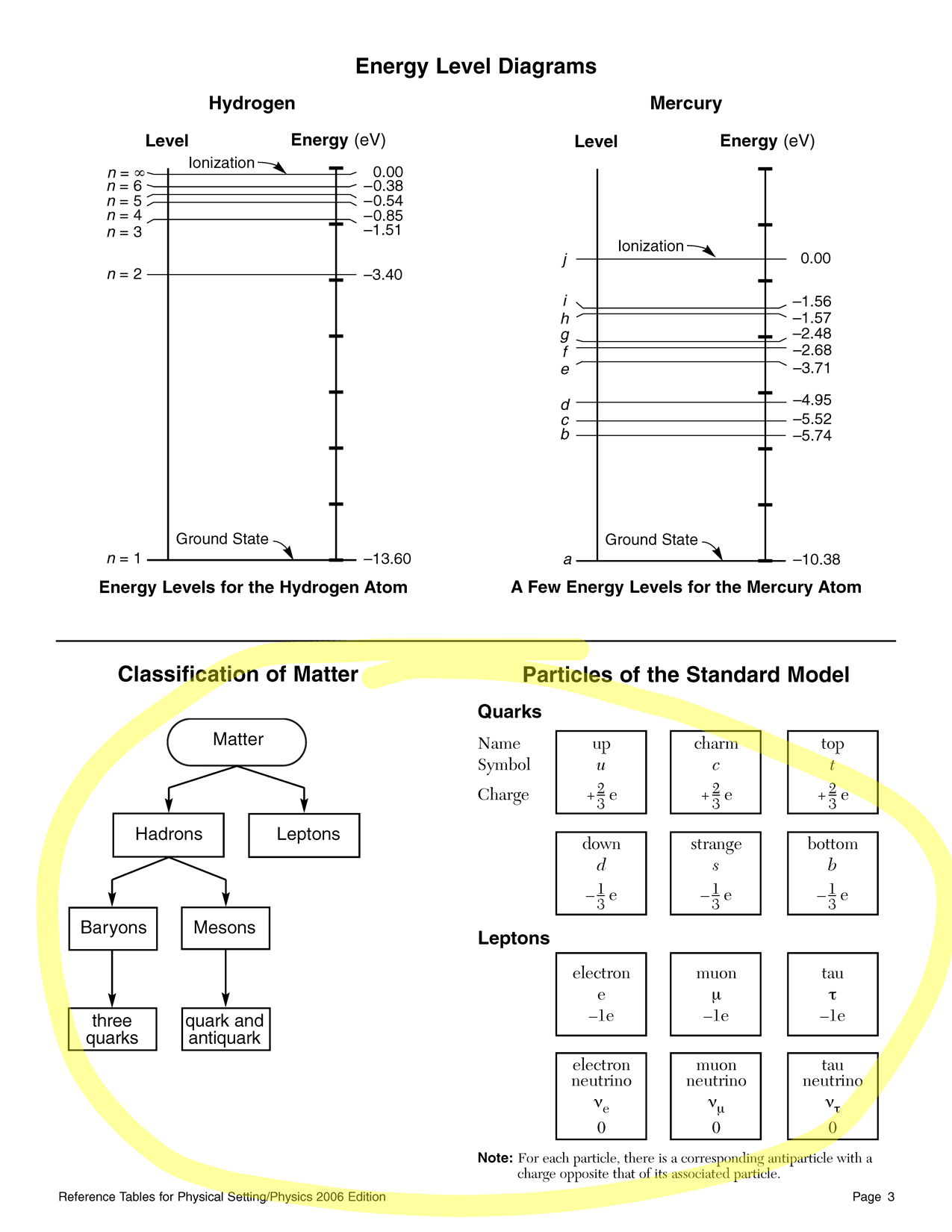


some review
- Two protons in a helium nucleus are sparated by a typical distance of 1.2 femtometers. (1 fm is 10−15 m.)
- Determine the electrostatic force between them.
- Is this force attractive or repulsive? Explain your answer.
- About how big is this force; that is, what might have a weight on Earth that is about as big as the value you calculated in part 1?
- Why doesn't the nucleus blow itself into pieces? What is holding it together?

Solutions…
Apply Coulomb's law. Consult your state-issued reference tables for the charge on a proton. All protons are identical, so I see no reason to write the charge twice. I'll just square it.
FE = kq1q2 r2 FE = (8.99 × 10⁹ N m2/C2)(1.60 × 10−19 C)2 (1.2 × 10⁻¹⁵ m)2 FE = 160 N This force between protons is repulsive. All protons have the same charge — identical in magnitude and sign. Like charges repel (like in the sense of having the same charge). That's just a fact of nature.
In the United States we still use pounds as a unit of mass and force. There are plently of online resources that can convert newtons into pounds of force for you. They all pretty much give the correct answer: 160 N is 36 pounds. You should be able to think of things that have about this weight to within an order of magnitude (power of ten). Anything weighing between 10 lbs and 100 lbs is acceptable. Not a paperclip, not an atom, not the Earth, not a horse, not a ping pong ball, not the Sun, not a grain of sand, not a car, not a sandwich.
Try also to learn the rule-of-thumb conversion that one newton is between ⅕ and ¼ pound. Thus 160 N is between 160 ÷ 5 = 32 lbs and 160 ÷ 4 = 40 lbs. An explanation as to why one newton is what it is in pounds is provided at the end of this pop up box.
160 newtons is an incredibly strong force when compared to the size of a proton. The nucleus does not rip itself to shreds because it is held together by the appropriately named stong nuclear force, the first topic in today's discussion.
bing.com 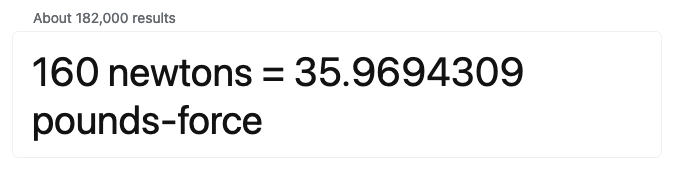
google.com 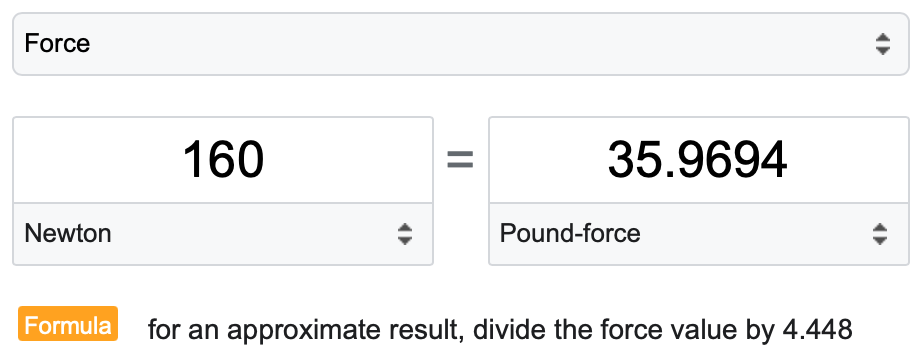
chat.openai.com 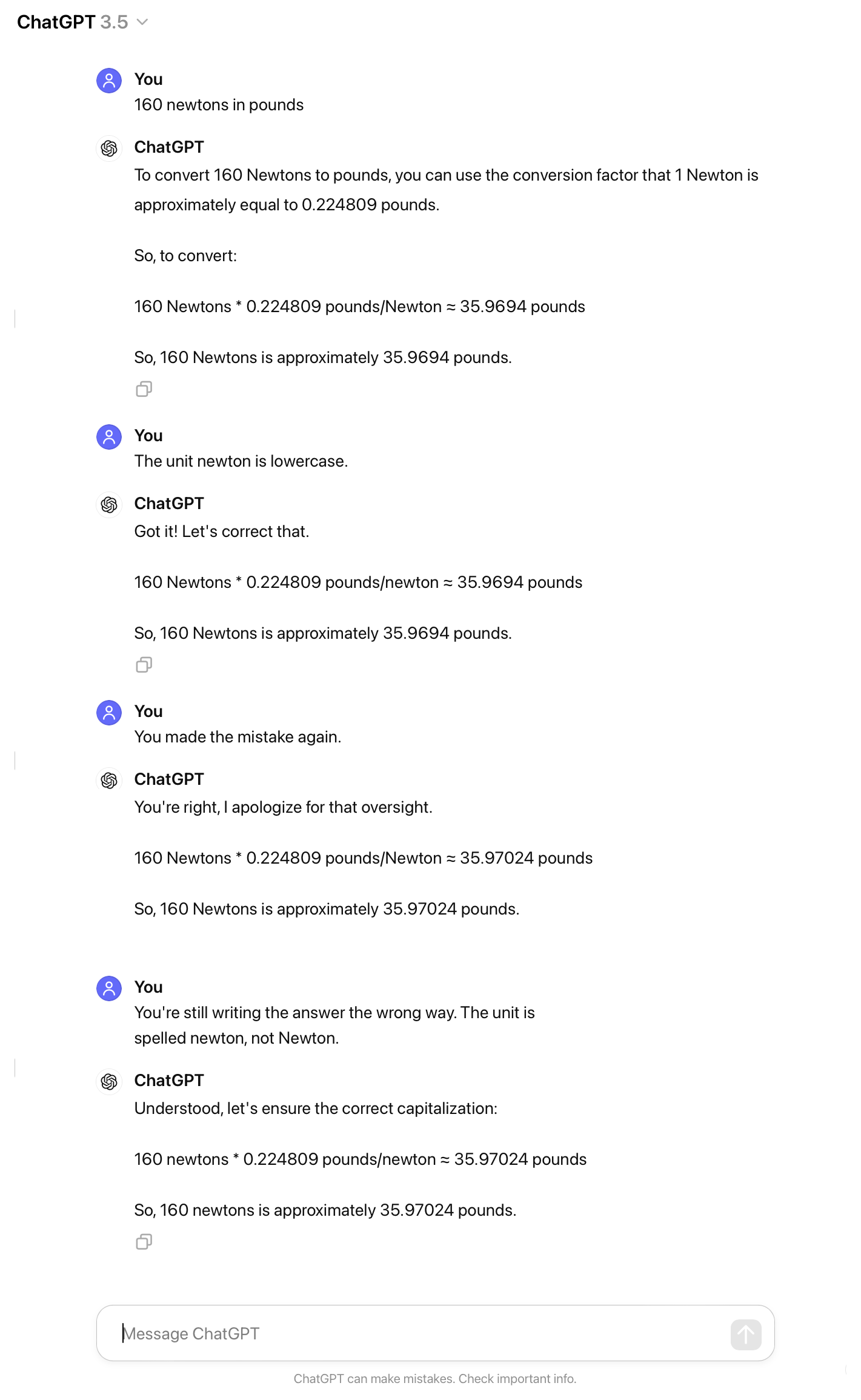
wolframalpha.com 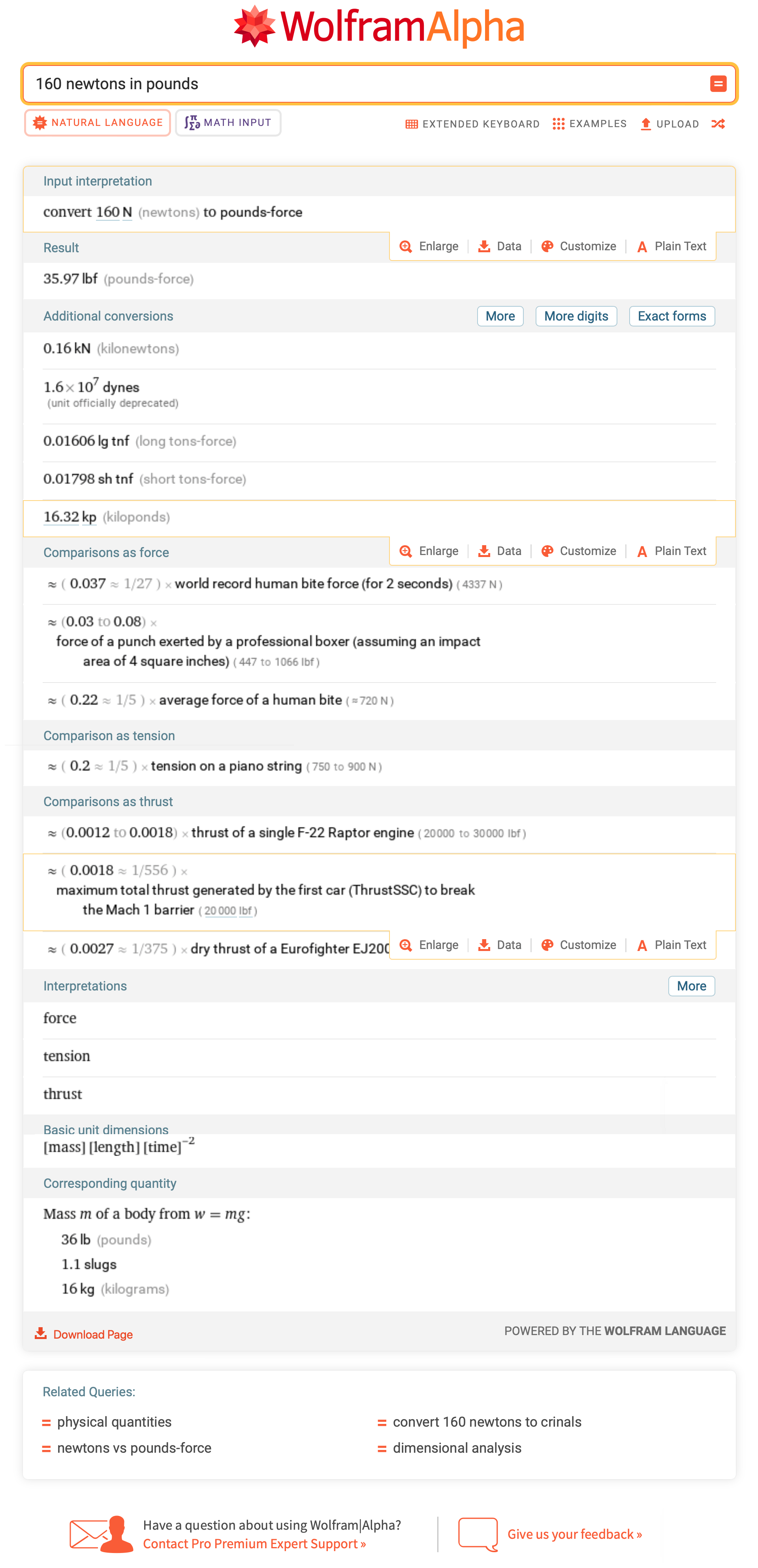
Here's the way I usually do it — using values I've memorized from years of use.
W = mg 2.2 lb = (1 kg)(9.8 m/s2) 1 lb = 4.45… N 1 N = 0.224… lb Here's a more accurate way to do it — using values that are exact by definition.
W = mg 1 lb = (0.45359237 kg)(9.80665 m/s2) 1 lb = 4.448221615… N 1 N = 0.224808943… lb Not quite a quarter pound, but you get the idea.
0.20 lb < 0.224808943… lb < 0.25 lb ⅕ lb < 1 N < ¼ lb The fraction 940 gives a decimal expansion of 0.225, which is accurate to three significant figures. Not my favorite fraction, but it gets the job done. With sixteen avoirdupois ounces in a pound, one newton is also about 3½ ounces.
1 N ≈ 9 lb × 16 oz = 18 oz = 3½ oz 40 1 lb 5
sample problem
- Combinatorics and quarks
- How many unique mesons can be made from just the up and down quarks? List the combinations and state their net charges.
- How many unique baryons can be made from just the up and down quarks? List the combinations and state their net charges.
Mesons are quark-antiquark pairs. Three or four mesons can be made using just up and down quarks. The answer depends on your notion of unique.
uu: (+ ⅔ e) − (+ ⅔ e) = +0 e
ud: (+ ⅔ e) − (− ⅓ e) = +1 e
du: (− ⅓ e) − (+ ⅔ e) = −1 e
dd: (− ⅓ e) − (− ⅓ e) = +0 eAre particles distinct from antiparticles? The middle two mesons in the list above are duplicates in a sense. One is the antiparticle of the other.
Baryons are three quarks glued together. Four unique baryons can be made using just up and down quarks.
uuu: + ⅔ e + ⅔ e + ⅔ e = +2 e
uud: + ⅔ e + ⅔ e − ⅓ e = +1 e
udd: + ⅔ e − ⅓ e − ⅓ e = +0 e
ddd: − ⅓ e − ⅓ e − ⅓ e = −1 e
homework
- The most common isotope of lithium is 73Li. How many of each of the following items are found in one of these atoms if it is electrically neutral?
- electrons
- baryons
- pentagons
- bonbons
- hadrons
- neutrons
- leptons
- morons
- protons
- borks
- sporks
- quarks